
Preprints and continuous publishing : 2025 strategy for Ibero-American publishers
1. A click that left the printed number behind
An illustrative story based on the testimonies of editors who adopted continuous publishing Lucía—editor-in-chief of the Journal of Plant Biochemistry—was reviewing the submissions panel, as she did every Friday. Four articles were needed to complete volume 42-2, and the publishing was nine weeks away. Then she remembered an email from an author requesting expedited inclusion of their findings in a CONICET project. She took a breath, gave the PDF, which had just been proofread, one last look, and clicked "Publish now." That seemingly trivial gesture broke two decades of tradition and initiated a transformation that keeps her journal publishing cycle .
"When I saw the active DOI on Crossref within ten minutes, I felt like we had been reborn," Lucía confesses. Six months later, her average time-to-cite had fallen by 64%, and downloads had increased by 140%.
Hers is not an isolated story. In the last three years, at least 37 journal have successfully migrated from closed issues to continuous or hybrid models.
2. Brief history: from printing to real-time DOI
- 17th-20th centuries: scientific journals grouped articles into fascicles, imitating books set in lead.
- 1970‑1990: Offset printing reduces print runs and special issues emerge, but the editorial workflow time is still measured in months.
- 2000‑2010: OJS democratizes digital editorial management , but maintains the "volume-number" paradigm.
- 2015‑2020: The emergence of preprint servers (bioRxiv, arXiv-q-bio, SciELO Preprints) demonstrates that the community is ready to consume science almost in real time.
- 2021–present: BMJ , PLOS , eLife , and dozens of other journal continuous publishing models . Readers demand immediacy, and discovery algorithms reward freshness.
3. Proven benefits
| Metrics | Traditional model | Publishing continues | Fountain |
| Time-to-cite (median) | 180 days | 72 days | ASAPbio Study 2024 |
| Downloads in 90 days | 1 000 | 2 300 | Rev. Med. LatAm (2023) |
| Altmetric Attention | 22 | 41 | Dimensions Analytics |
| Rejection due to obsolescence | 7 % | 2 % | Internal Data Index |
4. The role of preprints in early visibility
4.1 Why is SciELO still key?
4.2 Evidence of impact
- ASAPbio (2024) analyzed 7,200 preprint-final version pairs: those with a preprint received 23% more citations during the JIF window.
- The NIH Preprint Pilot showed that projects that cite preprints accelerate the transfer of clinical knowledge by an average of 11 months.
4.3 Fear vs. reality
5. Three continuous flow models
5.1 Classic Early View
You publish the final paginated version and then add it to the volume's index. Administrative simplicity, but the "preprint" concept disappears.
5.2 Labeled version + final version
5.3 Rolling Volume integral
6. Common obstacles and how to overcome them
Obstacle | Risk | Mitigation strategy |
Reader confusion | They cite the preliminary version | Top banner with link to latest version + Crossmark |
editorial workflow overload | Delays in correction | Outsource copy-editing; use macros in Word or online plugins |
Internal resistance | Fear of falling JIF | Internal metrics workshop: show real impact studies |
7. 90-Day Adoption Plan
- Week 1 – Kick-off:
Assemble your committee; define which of the three models aligns with your capabilities. - Week 2-3 – Preprint Policy
Publish a document that establishes: licenses, versions, recommended citation. - Week 4-5 – Technical test in Index
Activate the continuous publication in staging; upload a dummy article. - Week 6 – Author Training
30 min Webinar with step-by-step guides and citation format. - Week 7-8 – Pilot with 1-3 real items.
Measures times, errors, perception. - Week 9 – Go-live
You open the volume; you communicate on social media and mailing lists.
8. Expanded illustrative case: Spanish Journal of Chemotherapy
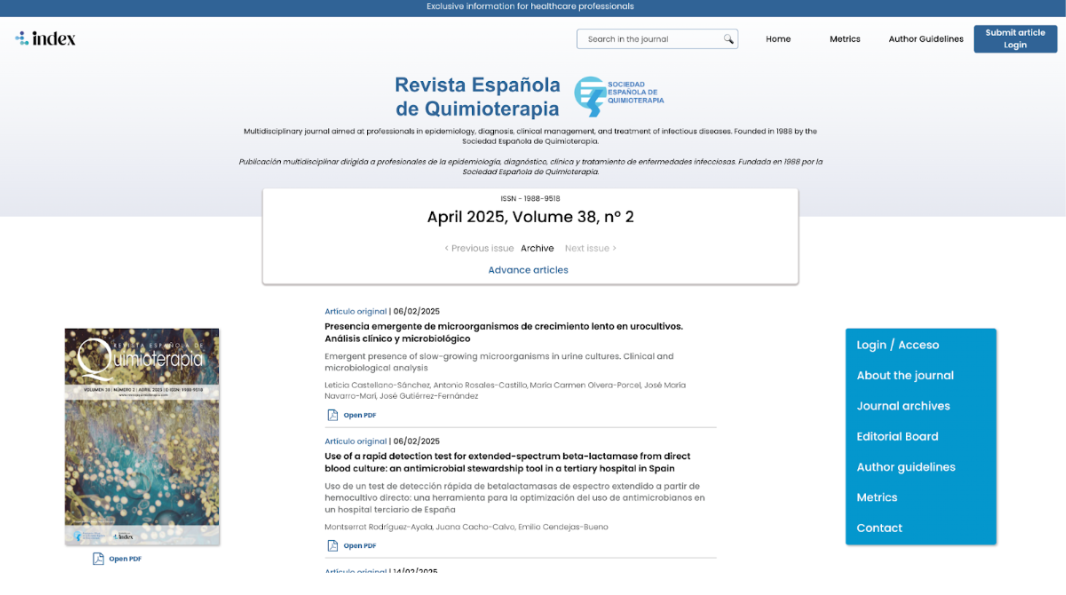
One of the most illustrative cases is that of the Spanish Journal , a leading scientific publishing peer review , the Index team handles the entire editorial workflow : technical review, copyediting, file generation (PDF, HTML, XML), and DOI assignment. Within a few days, the article is published online, fully citable and accessible in its final format, without having to wait for the issue to be finalized.
This strategy not only alleviates the editor's operational burden but also offers direct value to the author: having their work visible, downloadable, and citable in record time. From an impact perspective, publishing earlier is synonymous with circulating earlier. Thanks to integrated metrics and tracking systems, each article published in advance begins generating usage and visibility data from the outset, which facilitates its inclusion in future citations. In short: the editor saves time, the author gains relevance, and the journal amplifies its reach.
Index supports the Journal of Chemotherapy with a comprehensive solution that combines advanced editorial technology, continuous support and editorial workflow , allowing the journal to focus on what matters most: publishing rigorous science with agility and professionalism.
9. FAQ
What exactly is the “online advance”?
It is the early publishing of an accepted article, before the full issue is finalized. The article is published in its final version, with an active DOI, fully formatted, and ready to be cited.
What advantages does this have for the editor?
It reduces editorial bottlenecks, improves publishing times, and enhances the journal 's prestige by offering agility without sacrificing quality.
And what about for the author?
Their work is published, visible, and quotable much sooner. This allows it to start generating impact, accumulating downloads, and ranking in search engines from day one.
Is the article republished when the issue closes?
Yes. The article published in advance is then incorporated into the corresponding issue without changing the content or the DOI. Only its location within the volume is updated.
How is it managed technically?
Index automates much of the process: it produces the final files, assigns the DOI, updates the metadata, and ensures compatibility with indexing platforms such as PubMed, Crossref, or SciELO.
Does this affect metrics or citations?
On the positive side, the sooner an article is online, the sooner it can be read, cited, and shared. Publishing early reduces time-to-cite and accelerates the accumulation of visible metrics.
What implications does this have for the editorial committee?
None. The committee continues to evaluate manuscripts as normal; Index handles the entire post-acceptance phase.
Can I activate online advances only on some items?
Yes. You can decide on a case-by-case basis, for example in urgent clinical articles, international collaborations, or research with tight funding deadlines.
Do other journal in Index use it?
Yes, several medical and academic journal already use it successfully. It's an increasingly common practice in journal seeking to increase their impact without compromising rigor.
10. Practical conclusion
Early publishing allows you to accelerate your impact without compromising quality. For the publisher, it's an efficient way to reduce bottlenecks and improve turnaround times without taking on additional tasks. For the author, it means immediate visibility, earlier citations, and greater satisfaction. Implementing it with Index is simple, secure, and delivers real value from the very first article.
Want to cut your time-to-cite in half? Book a 20-minute call with an Index specialist and receive a preprint policy template tailored to your discipline.