
Index launches its new automatic typesetting tool: from Word manuscript to PDF, HTML and XML in minutes
In many scientific journal , the publishing of an article doesn't end when the manuscript has been accepted. In fact, that's when one of the slowest, most technical, and most expensive phases of the editorial process begins: production.
File review, typesetting , PDF generation, HTML preparation, XML-JATS markup, metadata review, coordination with authors, change validation, and final publishing . A process that, in many journal , still relies on external teams, email exchanges, multiple document versions, and difficult-to-control waiting times.
To address this problem, Index is launching a new typesetting automaticformats publishing in a faster, more structured, and scalable way.
A new way of producing scientific articles
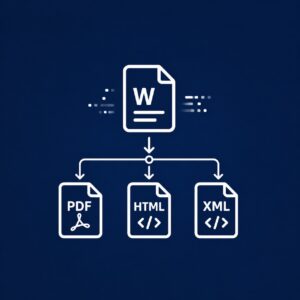
The new tool allows you to upload a Word manuscript and generate, from that content, the main publishing formats that a scientific journal needs:
– Editorial PDF, adapted to the journal.
– Web HTML, to improve online reading and content visibility.
– XML-JATS, key for indexing, interoperability, and technical preservation.
– EPUB or other formats, depending on the needs of the publishing project.
The goal is clear: to enable journal to move from accepted manuscript to publication-ready article without relying on lengthy, expensive, and fragmented manual processes.
It's not just about "layout faster." It's about transforming editorial production into a digital, traceable, and far more efficient workflow.
The major bottleneck in scientific journal
For years, many journal have digitized parts of the editorial process: article submission, peer review , online publishing , and DOI assignment. However, editorial production has remained one of the most manual aspects of the system.
The problem is especially visible in small and medium-sized journal , scientific societies, universities, and academic publishers that manage multiple publications. Each article can involve a chain of complex tasks:
Standardize titles, authors, affiliations and ORCID; review tables and figures; adapt references; prepare the PDF; convert the content to HTML; generate XML compatible with international standards; validate metadata; and coordinate final approvals.
When all of this is done manually, the result is usually the same: delays, high costs, cumulative errors, and dependence on external teams.
Index's new tool was created precisely to address this issue.
From document to structured content
Modern scientific publishing can no longer rely solely on PDFs. Articles must be readable not only by people, but also by search engines, databases, repositories, and indexers.
Therefore, the real value lies in transforming the manuscript into structured content.
With this new functionality, Index allows the article to be not only a visually correct document, but a digital piece prepared for better circulation: with organized metadata, reusable formats and a structure compatible with the standards of modern scientific publishing .
This improves the journal 's internal efficiency, but also its visibility, its indexing capacity, and its presence in academic search engines.
A tool integrated into the Index ecosystem
Automatic typesetting doesn't work in isolation. It's integrated within the Index ecosystem, which already allows you to manage the entire editorial workflow of a journal : manuscript submission, peer review , editorial decisions, production, web publishing , DOI, metadata, and final formats.
This allows connecting phases that were traditionally separate.
An accepted article can be sent to production, have its formats generated, be reviewed, and published all within the same environment. The journal gains control, reduces intermediate steps, and avoids losing information among folders, emails, and versions.
Technology does not replace editorial judgment. What it does is free the team from repetitive tasks so they can dedicate more time to what's important: scientific quality, editorial strategy, and journal growth.
Why it's a relevant innovation
Innovation isn't just about automatically generating a PDF. True innovation lies in connecting three needs that many tools address separately:
– Editorial production, to transform manuscripts into final formats.
– Publishing Digital, to ensure each article has a structured online presence.
– Technical preparation for indexing, using HTML, XML-JATS, and consistent metadata.
– Publishing Digital, to ensure each article has a structured online presence.
– Technical preparation for indexing, using HTML, XML-JATS, and consistent metadata.
In a context where journal must publish faster, meet more technical requirements and improve their international visibility, this layer of automation can profoundly change the way we work.
Especially for universities and publishing groups with several journal , the impact can be enormous: less dependence on manual processes, greater consistency between publications, and more scalable production.
A response to a real problem in the sector
Index developed this functionality based on direct experience with hundreds of scientific journal . The lesson learned was clear: many publications need more than just a website or a peer-review platform; they need a complete infrastructure to help them publish better.
Automatic typesetting responds to a very specific need: to reduce friction between article acceptance and final publishing .
Because a modern journal shouldn't take weeks to generate technical formats. It shouldn't rely on fragmented systems. It shouldn't manually repeat the same process over and over again.
Publishing production can be simpler, faster, and smarter.
Towards a new generation of scientific publishing
Scientific editorial management is entering a new phase. It is no longer enough to simply publish articles; they must be published in a structured, visible, interoperable, and sustainable way.
Index's new automatic typesetting tool represents a step in that direction: a way to convert scientific knowledge into digital content ready to circulate, be read, be cited, and be indexed.
In short, Index doesn't just help journal manage articles. It helps transform manuscripts into complete scientific publications, ready for today's digital ecosystem.
Convert your manuscripts to PDF, HTML, and XML in a more agile, structured, and scalable way.
With Index's new automatic typesetting tool, editorial production ceases to be a bottleneck and becomes a competitive advantage.