
Index vs. LaTeX typeset: the new alternative automatic typesetting software for scientific journal
For decades, LaTeX has been one of the most widely used tools for typesetting scientific documents, especially in fields such as mathematics, physics, engineering, and computer science. Its ability to produce technically accurate documents with complex formulas and consistent typographic structure has made it a benchmark in publishing .
However, when it comes to the editorial output of a journal , the challenge is no longer simply producing a well-formatted PDF. Today, journalneed to publish articles in multiple formats, maintain visual consistency across all their content, generate structured metadata, facilitate indexing , and reduce production times.
This raises a key question: Is LaTeX the best solution for a journal that needs to automate its entire editorial workflow?
What does “LaTeX typeset” mean in scientific publishing ?
When an author or editor searches for “LaTeX typesetting,” they are usually looking for a way to professionally format a scholarly article. In many cases, the need is clear: to transform a manuscript into a journalwith columns, references, tables, figures, formulas, and defined editorial styles.
Tools like Overleaf have helped popularize this workflow by providing LaTeX templates for journal, allowing authors to prepare manuscripts with a format close to that required by certain publications.
But in the professional publishing environment, typesetting doesn't end with the PDF. A journal needs much more than simply applying a template.
The limitations of LaTeX for scientific journal
LaTeX is a very powerful tool, but it doesn't always meet all the needs of a modern scientific journal . Its main strength lies in document formatting, especially when dealing with complex technical or mathematical content. But a publisher or management team needs to address other aspects:
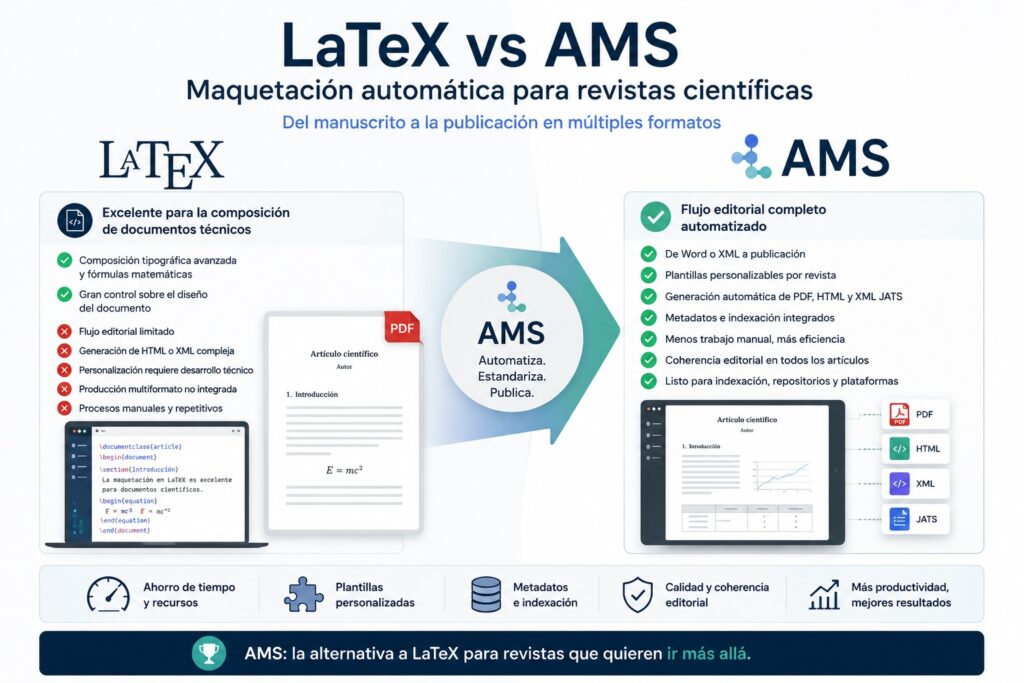
- generate multiple publishing formats from the same content;
- maintain a personalized visual identity for each journal ;
- adapt the design to specific editorial standards;
- produce JATS XML for indexing and preservation;
- reduce manual intervention on each item;
- facilitate galley proof corrections;
- coordinate metadata, references, authors, affiliations and DOI;
- Publish consistently in PDF, HTML, XML, and other formats.
In many traditional workflows, LaTeX can help generate a good PDF, but it doesn't always provide an integrated solution for the multi-format production and editorial structuring required by today's scientific journal . In fact, the literature on automated editorial workflows increasingly emphasizes the importance of extracting XML, generating multiple formats, and working with reusable editorial templates.
AMS: an alternative to LaTeX designed for journal , not just for authors
AMS, tool typesetting Index's automatic, is designed specifically for journalthat need to transform manuscripts into publish-ready content.
Unlike a workflow based solely on LaTeX, AMS doesn't just focus on composing a final document. Its goal is to automate the entire publishing process, from manuscript to publishing formats.
With AMS, a journal can convert its articles into:
- PDF layout;
- HTML for web publishing ;
- JATS XML for indexing , interoperability, and preservation;
- other editorial formats according to the needs of the journal .
This allows the editorial team to work with a more efficient logic: the same structured content can feed different outputs, reducing duplication, errors, and manual tasks.
Custom templates for each journal
One of the major advantages of AMS over conventional LaTeX is editorial customization.
Each journal has its own identity: fonts, heading styles, abstract structure, table handling, section hierarchy, reference format, headers, footers, pagination, licenses, DOIs, citation data, and overall design.
's image and standards journal. This means that automation doesn't imply a loss of visual identity. On the contrary, it ensures that all articles maintain a consistent, professional presentation aligned with the editorial brand.
While a LaTeX template is typically designed for preparing a manuscript or generating a PDF, AMS is geared towards supporting recurring editorial production, with stable and reusable criteria for each issue or volume.
From Word to PDF, HTML and XML JATS
A common challenge in scientific journal is that many authors submit their manuscripts in Word format rather than LaTeX. This forces editorial teams to dedicate time to cleaning up styles, checking references, structuring metadata, and preparing the files for publishing .
AMS responds precisely to this scenario: it allows the automation of transforming Word manuscripts into editorial formats ready for publication.
This point is especially important because in today's scientific publishing , JATS XML has become an essential format for interoperability, indexing , and digital preservation. Some academic production solutions already highlight the generation of PDFs, HTML, and XML as part of an automated editorial workflow, confirming that the sector is moving toward more integrated, multi-format systems.
LaTeX vs AMS: Main differences
LaTeX remains an excellent tool for authors who need to write complex documents, especially when working with formulas, technical notation, or advanced scientific structures.
But a journal needs more than just a writing or typesetting tool. It needs a system that connects typesettingformats publishing , and indexing.
Therefore, AMS should not be seen as a direct replacement for LaTeX in all cases, but rather as an editorial alternative for journalthat want to automate their scientific output.
| Need | Latex | AMS |
|---|---|---|
| Scientific typographic composition | Yeah | Yeah |
| Custom templates per journal | Yes, with technical development | Yes, geared towards the editorial flow |
| Production from Word | Limited | Yeah |
| PDF Generation | Yeah | Yeah |
| HTML Generation | Not always integrated | Yeah |
| JATS XML Generation | It requires additional processes | Yeah |
| Editorial workflow for journal | Partial | Yeah |
Advantages of AMS for editorial teams
AMS is designed to reduce the time editorial teams spend on repetitive production tasks. Its main advantages include:
1. Real automation of the production flow.
formats publishing with less manual intervention.
2. Customizable editorial design
Each journal can maintain its visual identity through templates adapted to its rules and style.
3. Multi-format production
The content can be transformed into PDF, HTML and JATS XML, avoiding working with each format as if it were an independent process.
4. Coherence between articles and issues
All articles follow the same criteria of structure, style and presentation.
5. Preparation for indexing
The generation of JATS XML and structured metadata facilitates interoperability with academic platforms, repositories and indexes.
6. Less technical dependence for the editorial team
The goal is not for each editor to have to master LaTeX, but to be able to manage a professional production from a more accessible workflow.
When should you choose AMS instead of LaTeX?
AMS is especially useful for journal that:
- They receive most manuscripts in Word format;
- They need to publish in PDF, HTML, and XML;
- They want to reduce typesetting times;
- They seek to maintain their own visual identity;
- They need to prepare content for indexing ;
- They manage several items per number;
- They want to avoid repetitive manual processes;
- They need a more traceable and scalable editorial workflow.
LaTeX may still be a good option for certain authors or disciplines. But when the need is editorial, multi-format, and production-oriented, AMS offers a more complete solution.
Automated Typesetting for Scientific Journals
publishing publishing and reusable workflows. The goal is no longer simply to produce a final PDF, but to generate content ready for distribution across various environments: websites, databases, repositories, indexing , and publishing platforms.
In this context, AMS enables journalto move towards a more agile, consistent, and professional production process.
Compared to a workflow based solely on LaTeX, AMS offers an alternative designed for editorial teams that need to control the entire process: from manuscript to publishing .
Conclusion
LaTeX will continue to be a benchmark tool for scientific typesetting. But today's journal need solutions that go beyond traditional typesetting.
AMS transforms typesetting into an automated, customizable, and multi-format editorial process. For journal looking to reduce time, improve visual consistency, and prepare their content for digital publishing and indexing , AMS is a robust alternative to traditional LaTeX-based workflows.
Are you looking for an alternative to LaTeX typesetting for your scientific journal ?
With AMS you can automate the typesetting of your articles and generate JATS PDFs, HTML and XML from an editorial workflow adapted to the needs of your journal .