
Index shares its experience on visibility and editorial production in the LatinREV Newsletter
At Index we continue to expand our participation in spaces linked to editorial management and scientific communication, especially those that allow us to share experiences and establish links with journal , universities and editorial teams from different countries.
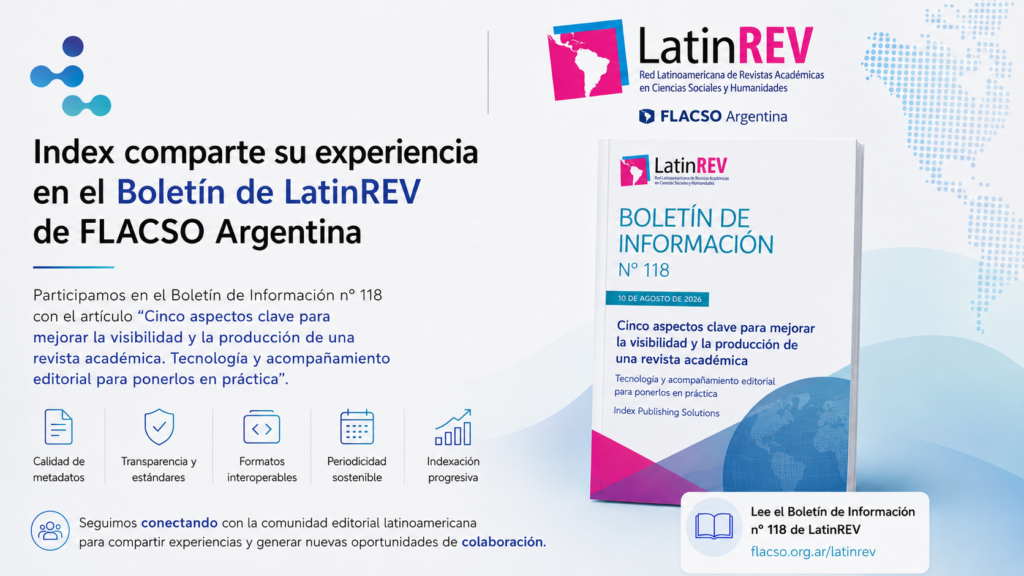
On this occasion, LatinREV, the Latin American Network of Journalin Social Sciences and Humanities of FLACSO Argentina, has published an Index contribution in its Information Bulletin No. 118, corresponding to August 10, 2026. The network currently brings together more than 2,960 journalfrom the region.
Our presentation, entitled "Five key aspects to improve the visibility and production of an journal . Technology and editorial support to put them into practice", addresses some of the issues we frequently encounter in our work with journal, scientific societies and editorial teams with very diverse structures and resources.
Five aspects that influence the visibility of a journal
Academic visibility doesn't begin when a journal submits an application to Scopus, SciELO, DOAJ, or any other database. It's built much earlier, through editorial, technical, and organizational decisions that affect the entire life cycle of a publishing .
In the article we address five of them: the quality and consistency of metadata, the transparency of editorial standards and the use of interoperable formats, the choice of publishing, the sustainable fulfillment of periodicity and indexing understood as a progressive process.
These are very different but closely related aspects. Good scientific content can lose visibility if its metadata is incomplete; a journal may have rigorous policies but lack transparency if these are not easily accessible; and an overly ambitious publication schedule can end up generating delays that affect the entire editorial process.
Therefore, one of the central ideas of our contribution is that technology alone does not solve the challenges of an journal academic. The tools must be accompanied by clear editorial criteria, sustainable procedures, and solutions tailored to the specific circumstances of each publishing.
Technology and editorial support
This perspective has also guided the development of Index's solutions. Manuscript management, metadata, PDF, HTML and JATS XML production, DOIs, and indexing processes should not be seen as independent tasks, but as parts of the same editorial workflow.
In the article we explain some of the ways in which we try to address these challenges together with the editorial teams: from the centralization of metadata and processes to multi-format production, DOI registration and deposit , or support in preparing a journal for different indexes and databases.
The goal is not to apply a one-size-fits-all solution to every publication. A journal with two issues a year and a small editorial team has different needs than a publishing with a high volume of articles or a journal preparing its application for a new index. Technology is truly useful when it simplifies these processes without causing journalto lose autonomy or identity.
Continue connecting with the Latin American publishing community
Our participation in the LatinREV Newsletter also represents an opportunity to continue getting closer to a publishing community that is especially active in Latin America.
Many journalin the region carry out essential academic work with small teams and limited resources, while simultaneously meeting increasingly demanding technical and editorial requirements. For this reason, we consider spaces that allow to share experiences journal, universities, networks, and scientific communication initiatives and learn about different approaches to challenges that, in many cases, are common, to be especially valuable.
We thank LatinREV and FLACSO Argentina for the opportunity to share our experience with their community and hope to continue participating in these types of spaces, exchanging knowledge and generating new connections with teams and institutions that work to strengthen editorial management .
The full article can be found in LatinREV Information Bulletin No. 118.