
AMS and OJS: How to automate editorial production without changing Open Journal Systems
The integration of AMS and OJS demonstrates how to automate editorial production without changing Open Journal Systems or altering the journal 's workflow. OJS has become an essential tool for thousands of scientific journal , universities, and academic publishers, as it allows them to manage manuscript submission, peer review , editorial decisions, and article publishing from a single environment.
However, even when a journal has a well-organized editorial workflow in OJS, the post-acceptance phase remains, in many cases, slow and manual: proofreading, typesetting , PDF preparation, HTML generation, XML-JATS creation, galley proof review, and applying changes to different files.
AMS is integrated at this point to facilitate editorial production without forcing the journal to abandon OJS or modify the way it works.
OJS continues to be the center of the editorial flow
The purpose of AMS is not to replace OJS. The journal can continue to use Open Journal Systems to manage authors, reviewers, editors, submissions, editorial decisions, issues, and publishing .
AMS is incorporated as a specialized production layer, between the accepted manuscript and the final article formats.
In this way, each tool takes care of what it was designed to do:
- OJS manages the editorial process and publishing .
- AMS transforms accepted content into professional formats ready for publication.
The editorial team maintains its procedures, its managers, and its usual environment. There is no need to rebuild the workflow or migrate the entire journal to a new platform.
How does AMS integrate with OJS?
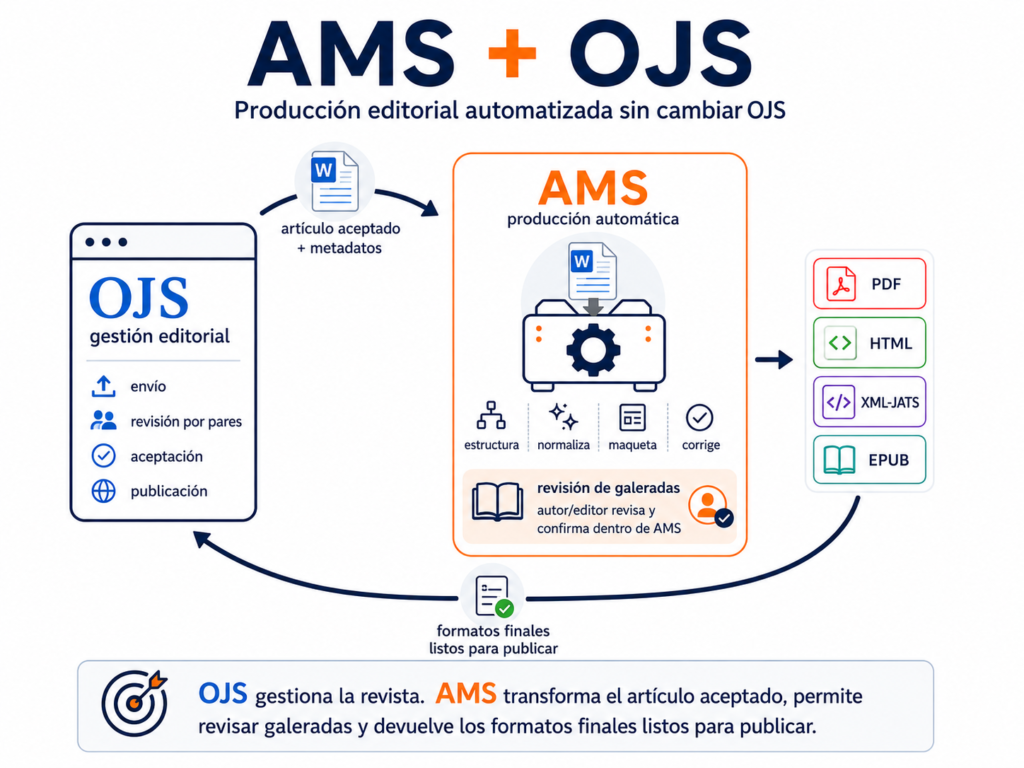
Once the article has passed peer review and been accepted, the final manuscript and its metadata can be incorporated into AMS to begin the production phase.
AMS interprets the document's structure and identifies its main elements: title, authors, affiliations, abstracts, sections, tables, figures, references, and other editorial metadata. It then normalizes the content and allows the team to review and correct the article before generating the final formats.
From a single structured source, AMS produces:
- PDF with the journal 's own design;
- HTML for online publishing and reading;
- XML-JATS for interoperability, preservation, and indexing ;
- EPUB and other formats when the project requires it.
Once validated, these files are incorporated back into the article in OJS as publishing formats or galley proofs. The specific method of exchange can be adapted to the technical configuration and procedures of each institution.
The result is a simple route:
Article accepted in OJS → production in AMS → editorial review → multi-format generation → publishing in OJS.
One single correction for all formats
In a traditional process, PDF, HTML, and XML are usually worked on separately. This means that a correction applied to one format won't always be correctly reproduced in the others.
AMS uses a single source of structured content. Therefore, the different formats are generated from the same information and remain synchronized.
This model reduces duplication, avoids conflicting versions, and facilitates proofreading. Furthermore, each journal maintains its visual identity through a custom template that is configured once and can be reused for subsequent articles
Especially useful for universities and publishing groups
The integration of AMS with OJS is especially interesting for universities, libraries, and publishing services that manage several journal from the same installation.
These teams often face a common challenge: each journal has its own design and its own rules, but the institution needs to maintain consistent technical criteria, control quality, and publish without continually increasing the resources dedicated to production.
AMS allows for standardization of the technical aspects without uniforming journal . Each publishing can maintain its masthead, fonts, styles, and editorial structure, while the institution works with a common and scalable production model.
This makes it easier:
- produce more items with the same equipment;
- reduce manual and repetitive tasks;
- maintain consistency between PDF, HTML and XML-JATS;
- reduce dependence on different suppliers;
- prepare structured content for distribution and indexing ;
- to better control the timing and quality of publishing .
Automation does not mean replacing the editorial team
AMS does not make scientific decisions nor does it replace the judgment of editors, proofreaders, or publishing managers. Its function is to reduce the time spent on mechanical operations and prevent the team from having to repeat the same corrections in multiple formats.
Automation allows professionals to focus on tasks where they truly add value: reviewing content quality, ensuring compliance with editorial standards, improving metadata, and developing the journal 's strategy.
OJS and AMS: a more complete editorial workflow
OJS offers a robust infrastructure for managing and publishing scientific journal . AMS expands its capabilities in one of the most complex phases of the process: transforming the accepted manuscript into a multi-format digital publishing .
It's not about changing platforms, but about adding a specialized tool where the workflow needs more support.
To test how it would work in a specific journal , a demonstration can be performed with a real article and transformed into PDF, HTML, XML-JATS and EPUB while maintaining the publishing 's design and editorial criteria.