
Convert PDF to XML: how AMS helps journals create structured publishing files
Scientific journals need XML because digital publishing depends on structured data.
A PDF can show an article to a reader, but XML allows the article to be understood by systems. This is especially important for academic publishing, where metadata quality, discoverability and interoperability are essential.
XML can help journals:
- improve indexing;
- structure article metadata;
- publish content in multiple formats;
- preserve articles digitally;
- connect content with DOI systems;
- generate HTML versions;
- facilitate repository deposits;
- improve search engine visibility;
- standardize editorial production.
For this reason, many journals do not only need to convert PDF to XML. They need to create high-quality, publication-ready XML.
The problem with basic PDF-to-XML conversion
There are many tools that can extract text from a PDF and generate an XML file. But this is not the same as creating a valid editorial XML file.
A basic converter may be able to extract the words from the PDF, but it can easily miss the structure of the article. Scientific articles are complex documents. They include metadata, references, tables, formulas, footnotes, figure captions and different levels of headings.
Some common problems in basic PDF-to-XML conversion include:
- incorrect reading order;
- broken paragraphs;
- missing metadata;
- incomplete references;
- incorrect author-affiliation matching;
- tables converted as plain text;
- figure captions not identified;
- section hierarchy errors;
- missing DOI or ORCID data;
- invalid XML structure;
- XML that cannot be used for indexing.
This is why journals usually need a more specialized workflow.
AMS: more than a PDF to XML converter
AMS is not just a PDF-to-XML converter. It is an automated editorial production system designed for scientific journals that need structured, consistent and publication-ready files.
Instead of treating XML as an isolated output, AMS integrates XML generation into a broader publishing workflow. This allows journals to move from static PDF files to structured content that can be published, indexed and reused across different platforms.
From PDF to XML-JATS
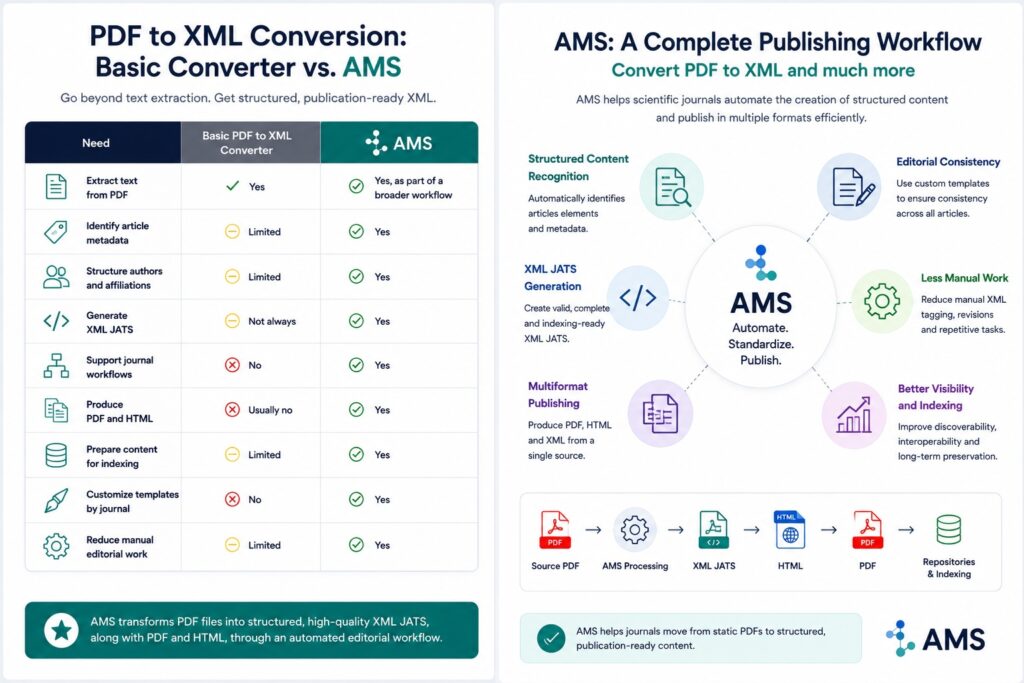
For scientific journals, one of the most important XML standards is XML JATS, a structured format specifically designed for journal articles. Unlike a simple PDF extraction, XML JATS identifies the key elements of an article, including metadata, authors, affiliations, abstracts, keywords, sections, tables, figures, references, DOI and publication information.
This makes XML JATS much more useful than a basic PDF-to-XML conversion, especially for journals that need reliable metadata and better indexing.
Why XML matters for journals
A PDF is useful for reading and downloading, but XML allows publishing systems, repositories and indexing services to understand the article structure.
A well-structured XML file can help journals improve discoverability, standardize metadata, support platform migration, preserve content digitally and increase the visibility of published articles.
PDF, HTML and XML from one workflow
One of the main advantages of AMS is that it supports multiformat publishing. Scientific journals often need to publish the same article as PDF for readers, HTML for the web and XML JATS for indexing and interoperability.
Managing these formats separately can create duplicated work and inconsistencies. AMS helps reduce this fragmentation by connecting PDF, HTML and XML production within a single editorial workflow.
When should a journal use AMS?
AMS is especially useful for journals that need to convert PDF to XML, generate XML JATS, recover structured content from archived articles, improve their digital publishing workflow or reduce manual XML tagging.
It is also useful for journals that publish several articles per issue and need consistent metadata, customized templates and standardized editorial production.
Convert PDF to XML vs. publication-ready XML
A basic PDF-to-XML converter may extract the text from a PDF, but scientific journals usually need more than text extraction.
Publication-ready XML requires accurate metadata, article structure, references, author affiliations, tables, figures and validation according to publishing or indexing standards.
| Need | Basic PDF to XML converter | AMS |
|---|---|---|
| Extract text from PDF | Yes | Yes, as part of a broader workflow |
| Identify article metadata | Limited | Yes |
| Structure authors and affiliations | Limited | Yes |
| Generate XML JATS | Not always | Yes |
| Support journal workflows | No | Yes |
| Produce PDF and HTML | Usually no | Yes |
| Prepare content for indexing | Limited | Yes |
| Customize templates by journal | No | Yes |
Advantages of AMS
AMS helps journals transform PDF-based content into structured publishing files with less manual work. It supports XML JATS generation, multiformat publishing, customized journal templates and consistent editorial production across articles, issues and volumes.
For new articles, AMS can help generate PDF, HTML and XML from the editorial workflow. For archived articles, it can support the recovery of structured content from existing PDF-based publications.
Frequently asked questions
Can I convert any PDF to XML?
In many cases, yes, but the quality of the result depends on the structure of the original PDF. A clean, well-structured article is easier to process than a scanned or poorly formatted document.
What is the difference between XML and XML JATS?
XML is a general markup language. XML JATS is a specific XML standard designed for journal articles and scientific publishing.
Why is XML JATS important for journals?
XML JATS helps structure article content and metadata so that platforms, repositories and indexing systems can process it correctly.
Does AMS generate only XML?
No. AMS is designed for multiformat publishing and can support PDF, HTML and XML JATS outputs.
Conclusion
Converting PDF to XML is an important step for journals that want to improve digital publishing, indexing and preservation. However, a basic PDF-to-XML converter is often not enough for scientific publishing.
AMS offers a more complete alternative: an automated editorial workflow that helps journals generate structured XML JATS, together with PDF and HTML outputs, using templates adapted to each journal.
Looking for a better way to convert PDF to XML for your journal? AMS helps scientific journals automate XML JATS production and publish articles in PDF, HTML and XML from a structured editorial workflow.